Oven Repair
Why does one side of the tray burn?
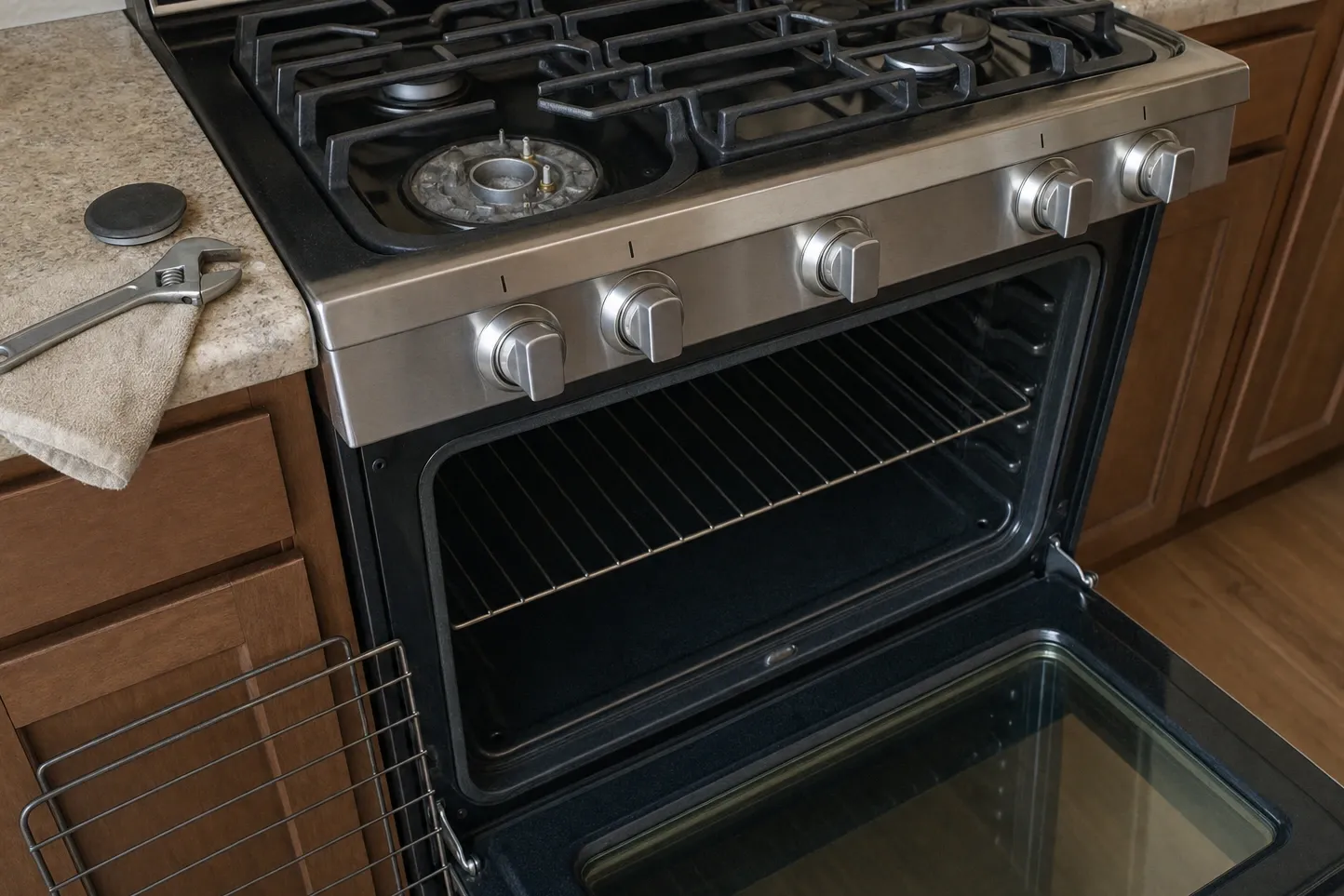
One side of a tray browning first is almost never a sign that the oven is at the wrong temperature. It can be sitting exactly on the number you chose and still do this all afternoon, because uneven baking is a question of where the heat goes once it is in the cavity, not how much of it there is.
That is better news than it sounds. Plenty of them end with nothing replaced at all and something simply loaded differently, and you can work through that side of it yourself this evening.
Airflow, and what blocks it
Heat does not sit still in an oven. It circulates, and anything standing in the way of that circuit casts a shadow on whatever is behind it. Most shadows are put there by the cook.
The usual suspects are a tray almost as wide as the shelf, two trays side by side on the same shelf, and a baking stone or steel plate that lives in the oven permanently and is never taken out. Each of them turns a cavity that moves heat around into a cavity with a wall across it.
Foil laid over the floor of the oven deserves singling out, because it is common and because it is remarkably good at making a healthy oven look broken. It changes both the way air moves through the cavity and the way heat is distributed around it. What the manufacturer says about it for your particular oven is in your own use and care guide, and that is a far better authority than anything written about ovens in general.
If your oven has a convection fan and you have been cooking with it, it has been hiding a certain amount of ordinary unevenness by keeping the air moving. The week that fan stops turning, everything it was papering over arrives at once, and it feels like a brand new fault rather than an old one becoming visible.
The door, the seal and the corner that runs cool
Heat leaves an oven wherever it can, and the door is the weakest part of the box by design: it is the only side that has to open. A door that has dropped even slightly no longer presses the seal evenly all the way round, and the part of the frame where it stands proudest runs cooler than the rest of the cavity. Whatever is on that side of the tray comes out pale, and everything else looks burnt by comparison.
You can see this without tools and without heat. A seal that has stopped gripping shows up in the paper test, which the door gasket article sets out position by position, and it takes a minute on a cold oven. While you are down there, run a finger along the seal itself and look for runs that have gone flat, hard, split or missing at a corner.
There is a local wrinkle. Along the coast through Venice, Marina del Rey and Playa del Rey, salt air stiffens seal material faster than it does inland and encourages corrosion where hinges pivot. A hinge that has gone stiff is a hinge that has stopped pulling the door up square, and it shows itself in the baking long before anybody thinks to blame the door.
Rack position and what is actually on the shelf
Whatever surface is nearest dominates. A shelf set high browns tops quickly, a shelf set low browns bases, and a shelf crowded edge to edge shades itself. Dark, heavy pans soak up heat and hold it; thin shiny ones bounce it back. None of that is a fault, and all of it is worth one experiment before you spend money.
Leave a hand’s width of clear air around a tray. Bake on one shelf at a time when the result really matters. There is no universal shelf rule worth quoting here, because the right position depends on the oven and on the dish, and the positions printed in your own use and care guide for the kind of cooking you are doing beat any rule of thumb written by a stranger.
The faults left when none of that is it
Work through the loading, the seal and the shelf, and what remains is a shortlist. A convection fan turning slowly, or not at all, leaves a cavity that has never had to be even and now has to be. A heating element that has failed partway delivers less to one region than another. A door that needs hinge work rather than an adjustment goes on leaking heat no matter how carefully it is closed. And a cavity whose airflow has changed can leave the temperature sensor sitting somewhere that is no longer representative of the oven as a whole.
What separates those is measuring in several places at the same time, which is exactly the thing a single thermometer on a single rack cannot do. That is the job Viking Repair Pros of Los Angeles turns up to do on (213) 652-7030, and the $89 covers finding out which of the shortlist you actually have before any part is discussed.
Follow-ups
Should I just turn the tray round halfway through?
Turning the tray is a perfectly good answer to a mild difference, and professional kitchens do it without embarrassment. Treat it as a workaround rather than a verdict, though: if you have only recently had to start doing it, something changed, and what changed is usually the door or the fan.
Is it worse with convection on or off?
Off, usually, because moving air evens out the differences a still cavity leaves behind. That makes the setting a useful test as well as a mode: if the unevenness disappears the moment you switch it on, airflow is doing its job and you are looking at loading and the door rather than a failed part.
Can a brand new oven bake unevenly straight out of the box?
It can, and it is worth checking early rather than living with it. A door can be out of square from the day it was installed, and a cavity can be fitted with a fan that was never right. Anything of that kind is a warranty conversation with your dealer first, so raise it while that option is open.
Part after
Back to Oven Heat